| Issues
More about other 'Cycles'.
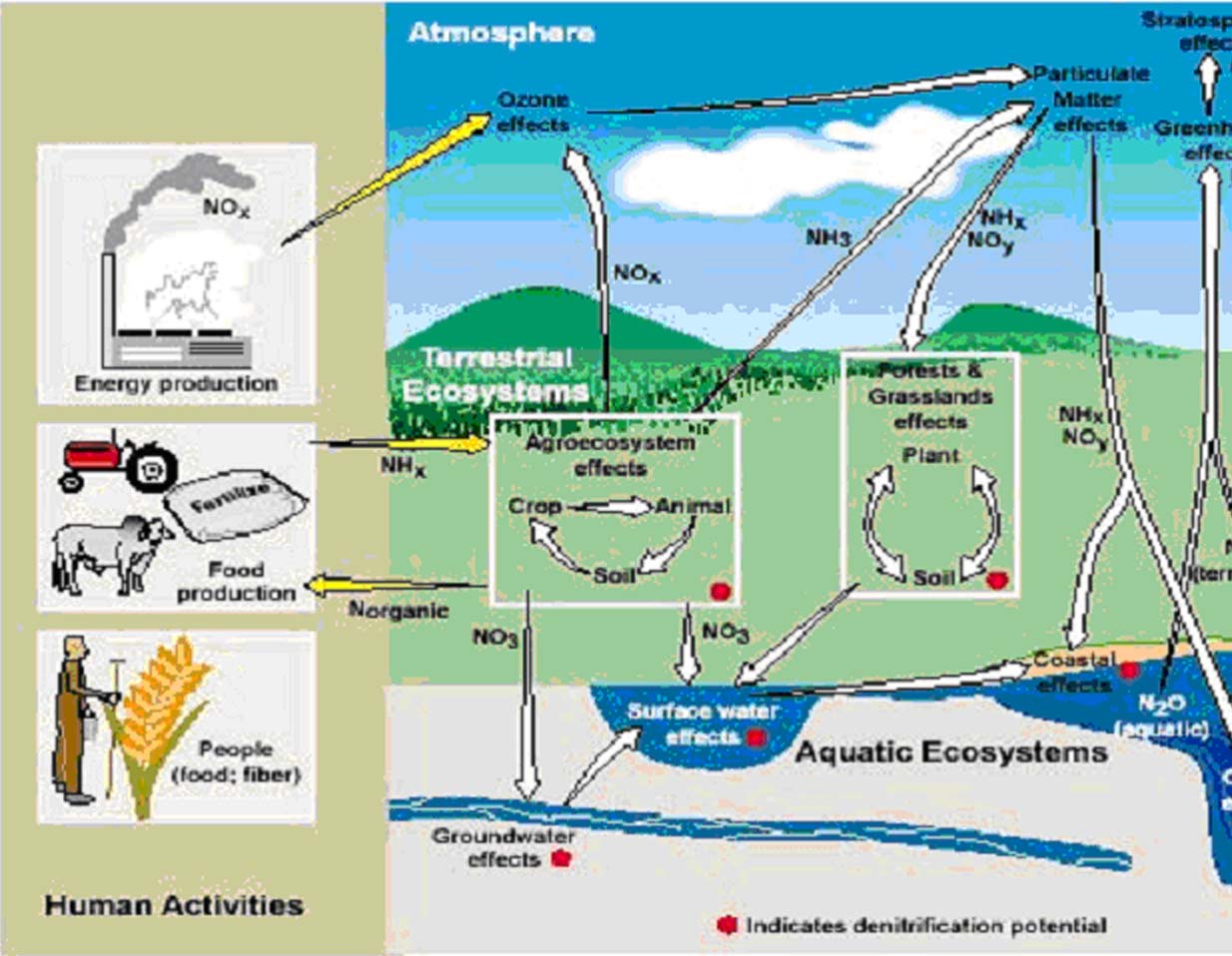
The natural nitrogen cycle (More about all 'Cycles) has been totally overun by a torrent of "reactive" nitrogen (glossary link).
See New Scientist graphic for changes.
|
| Nitrous Oxide is not a laughing matter...
Nitrogen Fertilisers while helping to feed an estimated 3billion people, hit all the wrong environmental buttons..
 |
UNEP Year Book 2010 (p28) says "The nitrogen cycle is in hyperdrive. A major study in 2009 identified human interference in biogeochemical cycles, particularly the nitrogen cycle, as one of three key areas where ‘planetary boundaries’ have been crossed, threatening Earth’s habitability. The others are climate change and the rate of biodiversity loss An estimated 120 million tonnes of atmospheric nitrogen per year is converted into reactive forms through human processes, mainly the manufacturing of fertilizers and the cultivation of leguminous crops such as soybeans". (Ed: Does anybody know what is the proportion of each?) The "planetary boundary" is estimated in the Yearbook to be about 35mt/reactiveN/yr, so we are excceding that level over 3X. |
1. Major greenhouse gas emitter
Worldwide N fertilisers are the largest source of GHG emissions in agriculture - 38% , according to Stern Report Agriculture Annex 7.f (compared to methane in Meat 31%). Fertilisers provide the single largest source of nitrous oxide emissions in the world.
Globally: pesticide production releases 72 million tonnes of Greenhouse Gases (GHGs: a mixture of gases, mainly CO2). Compare this with fertilizer production at 410 mt and the release of nitrous oxides from fertilized soils at 2122 mt of CO2e (This CO2 e = 'Equivalent' which translates the NOx into CO2) (Greenpeace: Cool Farming pdf) In other words fertilisers contribute over 25X more to climate change than pesticides do.
United Kingdom:
a. Manufacturing and transport of fertiliser are estimated at 6.7 tonnes CO2e for each tonne of Nitrogen fertiliser. Thus as 850,000 tonnes used in UK, this = 5.7mt CO2e. Out of a total UK GHGs of about 180 mtonnes, this = about 3%. Most N fertiliser production is abroad (East Europe), with about 800,000 tonnes imported
b Add to this the nitrous emissions following fertiliser application. In the UK, NOx are 6 per cent of UK greenhouse gas emissions (parliamentary answer). Agriculture contributes 2/3 of this - ie 4%.
A Life Cycle Analysis (DEFRA funded) into the environmental burdens and resource use in the production of agricultural and horticultural commodities shows that Nitrous oxide (N2O) is the single largest contributor to global warming potential (GWP) for all commodities except tomatoes. Summary of findings
So N fertilisers are responsible for 4% of direct UK GHG emissions - more than for all aircraft (a mere 10mt - see total UK GHGs ), and a further 5.7 mt tonnes CO2e in indirect emissions going over Eastern Europe.
Livestock accounts for about 65% of human made nitrous oxides according to LEAD.
Nitrous oxide is a major contributor to climate change (4-6% in UK) - and about 300X more potent than carbon dioxide.
2. Uses masses of oil.
The manufacture of Nitrogen fertiliser is the single main cause of energy use in non-organic farming, accounting for 37% of the total. More from Soil Association.
3. Reducing plant species biodiversity
Studies of the longest running ecological experiment in the world - the Park Grass plots at Rothamsted, showed that while there may be increases in biomass, there was a decline in species with regular fertilisation: "The addition of phosphorus reduced species (of plants) richness, and application of potassium along with phosphorus reduced species richness further, but the biggest negative effects were when nitrogen and phosphorus were applied together".
4. Making ozone at ground level,
5. Reducing ozone in stratosphere and
|